
At a Glance:
- Client: Matter Labs, the team behind ZKsync
- Moonsong’s role: Embedded engineering partner. Led the design and build of Prividium’s™ privacy, permission, and authentication infrastructure.
- Timeline: ~15 months, from proof-of-concept to production
- Outcome: Prividium™, Matter Labs’ flagship institutional platform, now being used to build Deutsche Bank’s Memento fund management chain, the Cari Network of US regional banks, and BitGo’s institutional tokenized deposit infrastructure
Meeting the Institutional Moment
Blockchain transactions are open by design. That’s a feature for consumer applications, but a deal-breaker for banks, asset managers, and regulated enterprises.
Matter Labs, the team behind ZKsync, understood this early. Their zero-knowledge privacy stack gave them the raw material for institutions. What they needed was a partner to build it.
That’s where Moonsong stepped in.
The Challenge
Moonsong’s initial mandate was a 2-month engagement to prove out the concept of institutional-grade privacy on a public chain.
The architecture decision came down to one question: fork the protocol, or build privacy as a new privacy layer?
Forking fails on three fronts:
- Engineering cost. Maintaining a parallel protocol is an enormous ongoing lift.
- Production risk. Modifying tested, audited protocols raises red flags for institutional buyers and adds time and budget to go-to-market.
- Ecosystem compatibility. A forked protocol severs compatibility with Ethereum wallets, contracts, tooling, and frameworks.
So we built an institutional privacy layer.
Our goal was to enforce privacy consistently across every surface intended to be public and open, from the RPC layer, to the block explorer, and application layer. All without breaking existing integrations or changing the blockchain protocol underneath.
And it had to meet the authentication and auditability requirements institutions depend on.
That meant solving four core challenges:
- Two authentication models, one system. Institutional IT relies on SSO and SAML, in which a central provider vouches for each user. Blockchain runs on self-sovereign proof. Users prove wallet ownership, and no authority vouches for anyone. The system needed to support both under a unified permission model.
- Privacy without breaking Ethereum tooling. Developers need to keep using the tools they know. The privacy layer we built couldn’t require rebuilding the ecosystem infrastructure.
- Permission management systems at scale. Granular control across users, addresses, contracts, and data types, managed through an interface that compliance teams could actually operate.
Enterprise security infrastructure from day one. API key authentication, IP whitelisting, multi-factor authentication, session management, and audit trails.
How Moonsong Approached It
The initial engagement proved the concept that institutional-grade privacy could be enforced as a layer with ZKsync without touching the underlying protocol.
From there Moonsong worked as an embedded engineering partner with Matter Labs to build for production.
“Moonsong acted as a true extension of our development team. They were deeply involved in the 0-1 design and build of the Prividium™ product, ensuring we built a product that solved the right problems for our customers while making the hard calls about how to enforce privacy without breaking Ethereum compatibility.
They stayed with us from the first proof of concept through production deployments and as customer requirements changed they adjusted with us. They knew when to move fast and when to slow down and get the architecture right.” – Noah Pravecek, Head of Product (Interop), Matter Labs
Matter Labs led client validation sessions with enterprise and institutional stakeholders, translating real compliance and operational requirements into concrete specifications. Moonsong took those specifications and built with an iterative approach across the stack’s permission model, architecture, and enforcement logic.
As client interest grew, the teams collaborated across every phase of design and build.
The result of that process was Prividium™.
What Moonsong Enabled
Prividium™ is the only Ethereum-secured blockchain platform purpose-built for institutions. It’s designed for organizations that need privacy, compliance, and full control of their data.
Core Components:
- A centralized permission system. An admin panel and permission API that serves as the control hub for access definitions across the entire stack. Compliance teams can manage who sees what, at the level of individual addresses, contracts, methods, and data types.
- An authentication, filtering, and access control layer. Sits between applications, wallets, and blockchain data. Filters transactions and wallet interactions in real time, enforcing access control before data ever reaches the end user.
- A privacy-enabled block explorer. Modified from ZKsync’s own block explorer. Authentication via Sign-in with Ethereum (SIWE) and enterprise SSO. Data visibility scoped to user permissions, while the core explorer functionality remains intact.
- An enterprise security framework. Authentication flows, session management, API key controls, IP whitelisting, MFA, and audit trails. The full security posture that regulated institutions require before any system touches production.
- Enterprise integrations. Compatibility with Fireblocks, Okta, BitGo, and standard Ethereum developer tooling including MetaMask, Hardhat, and Foundry.
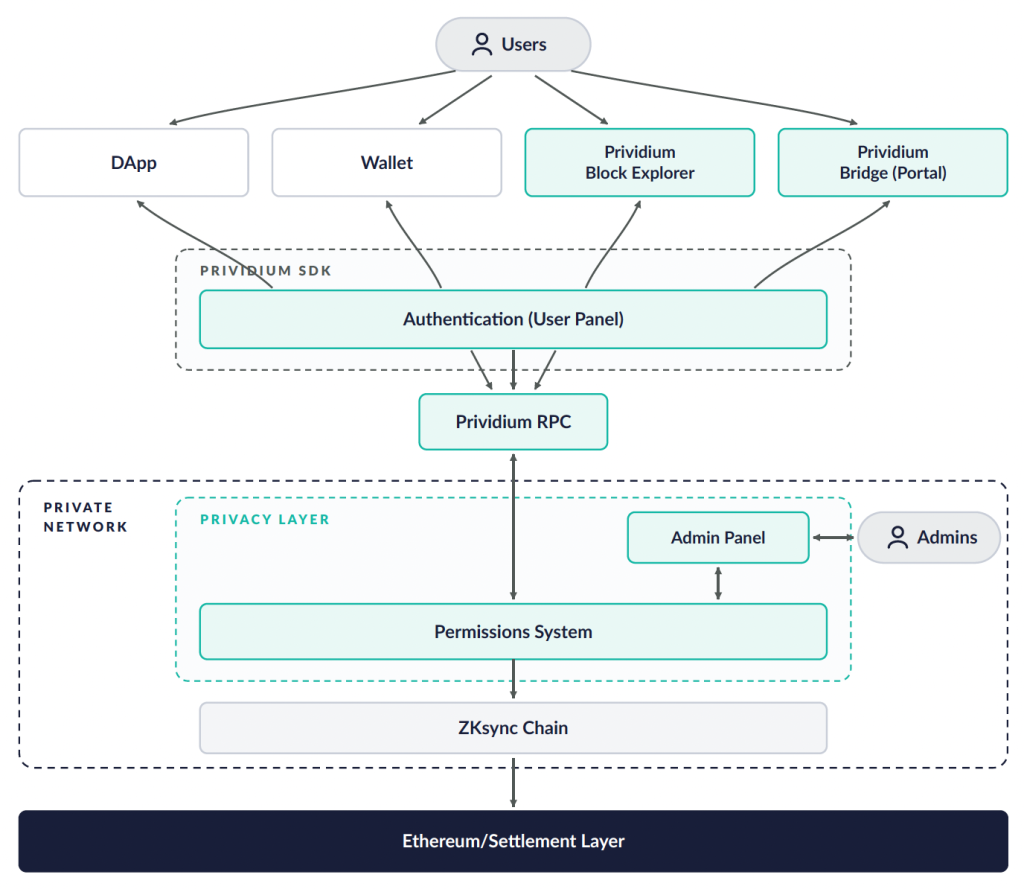
Source: Prividium™ Architecture
Prividium Today
Today, Prividium™ is Matter Labs’ flagship institutional product. It’s the centerpiece of their 2026 go-to-market strategy for regulated finance.
Marcin Michalski, who led Prividium’s™ technical development as Matter Labs’ CTO, on the Moonsong partnership:
“Enterprises and regulated financial teams need blockchain solutions they can trust for privacy, compliance, and control. Moonsong did an amazing job – they understood this from day one and helped us build the foundational infrastructure for Prividium™.
They worked closely with us from the early design, through proof of concept and all the way to production deployments. They have been a great, flexible partner as our needs have evolved.”- Marcin Michalski, former CTO, Matter Labs
Since launch:
- Deutsche Bank selected Memento blockchain, built on Prividium™ infrastructure, to modernize fund management. The deployment compresses fund launch timelines from months to weeks while maintaining full institutional compliance controls.1
- The Cari Network, a bank-governed tokenized deposit network led by former US Comptroller of the Currency Gene Ludwig, selected Prividium™ to power settlement infrastructure for US regional and mid-sized banks.2
- BitGo, one of the most trusted names in institutional crypto custody, partnered with Matter Labs to combine its custody and wallet services with Prividium™. Together, they enable banks to issue, transfer, and settle tokenized deposits under full compliance controls.3
If your organization is evaluating blockchain infrastructure for tokenized deposits, private settlement, or compliance-grade transaction management, you already know the hard questions.
Moonsong can help you answer them.
FOOTNOTES
- BusinessWire: Deutsche Bank, Axelar and Memento Blockchain’s DAMA 2 Litepaper Delivers an Institutional Blueprint for Asset Tokenization and Servicing on Ethereum L2 (June, 2025)
- CoinTelegraph: Cari picks ZKsync’s Prividium as US regional banks join stablecoin race (March 2026)
- ZKSync: BitGo and ZKsync Partner to Power Bank Adoption of Tokenized Deposits (March 2026)